


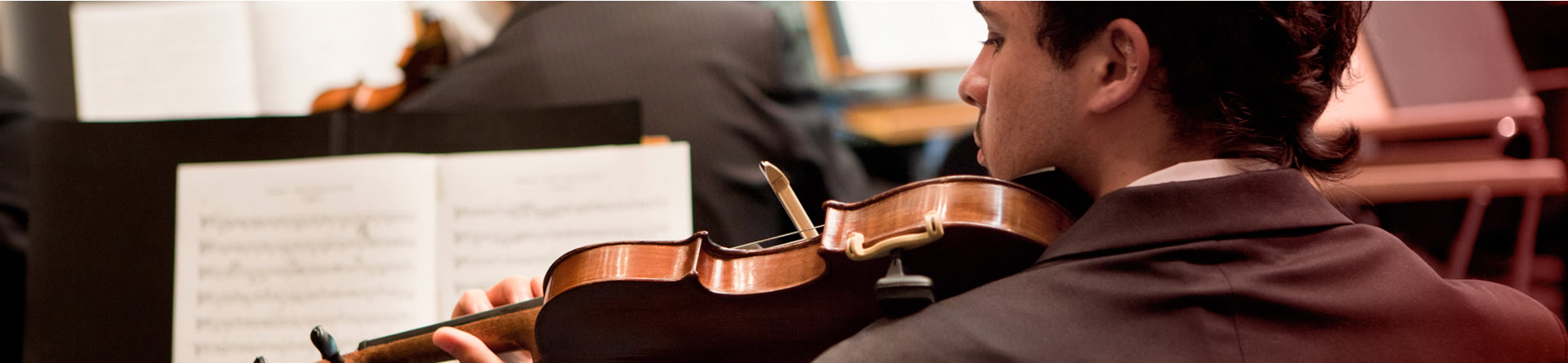
Since its early beginnings, the Graduate Program in Music has worked to promote academic research and artistic practice, striving to produce new knowledge in music. Our graduates have successfully pursued professional work in the academic and artistic areas, both in Brazil and abroad. The graduate program seeks to foster innovation and research in music through exchanges and partnership agreements with other institutions, as well as through scientific meetings, workshops and masterclasses with distinguished performers and music scholars.
Scope: The Graduate Program in Music is characterized by a strong commitment to excellence in teaching and research, which is reflected in the composition of its faculty, research subjects and curriculum structure. The program aims to promote innovative musical studies incorporating research and practice in different aspects of music at the masters and doctoral levels. To prepare students for roles as artists, teachers and scholars, the program’s curriculum strives to offer advanced training that qualifies them to act in a critical way, with an emphasis on the artistic specificity of the area.
Mission Statements: The mission of the Graduate Program in Music at USP is to promote innovative musical studies that incorporate research and practice in various aspects and areas of music at the masters and doctoral levels. To achieve this mission, the specific goals are:
Training of students for careers as scholars and teachers in colleges and universities;
The development of innovative research that generates new knowledge in music and its connections;
The promotion of academic and artistic production in music.
Faculty
Concentration area: Musicology
Research line: Teory and Music Analisys
Adriana Lopes da Cunha Moreira
Paulo de Tarso Camargo Cambraia Salles
Silvia Maria Pires Cabrera Berg
Research line: Musicology and Etnomusicology
Mário Rodrigues Videira Junior
Silvia Maria Pires Cabrera Berg
Susana Cecília Almeida Igayara de Souza
Concentration area: Music Criation Process
Research line: Performance
Eduardo Henrique Soares Monteiro
Research line: Interpretative Questions
Eduardo Henrique Soares Monteiro
Susana Cecília Almeida Igayara de Souza
Fátima Graça Monteiro Corvisier
Research line: Music and Educacion: Criative Process, Teaching and Learning
Fátima Graça Monteiro Corvisier
Linha de Pesquisa: Sonologia: criação e produção musical
Fernando Henrique de Oliveira Iazzetta
Subjects
Line of Research in Performance
The candidate for the title of Master in the line of research in Performance should disburse a minimum of 96 (ninety-six) credits, distributed as follows:
- 28 (twenty-eight) credits, with at least fourteen (14) credits due to the semestral participation in compulsory practical subjects specifically related to the line of research in performance
- 68 (sixty-eight) credits in the preparation of the dissertation;
The candidate for the title of Doctor in the line of research in Performance, with the prior obtainment of the title of Master, shall disburse a minimum of 178 (one hundred seventy-eight) credits, distributed as follows:
- 35 (thirty-five) credits, at least 28 (twenty-eight) credits due to the semestral participation in compulsory practical subjects specifically related to the line of research in performance
- 143 (one hundred and forty-three) credits in the preparation of the thesis.
The candidate for the title of Doctor in the line of research in Performance, without first obtaining the title of Master, should disburse a minimum of 199 (one hundred and ninety-nine) credits, distributed as follows:
- 56 (fifty-six) credits, with at least 35 (thirty-five) credits due to the semestral participation in compulsory practical subjects specifically related to the line of research in performance
- 143 (one hundred and forty-three) credits in the preparation of the thesis;
Note: The student may substitute up to seven (7) credits for courses with special credits (with the agreement of the duly recognized official mentor on the specific form). The CCP will analyze and consider the application for incorporation of special credits. IV.2. Other Lines of Research
Compulsory subjects (only for line of research in performance)
Students in the line of research in Performance will be required to fulfill credits in compulsory practical subjects, to be chosen from the following: Master's degree (14 credits):
Musical Performance I-II (Piano, Strings and Guitar)
or
Laboratory Practice in Choral Conducting I-II
PhD (28 credits):
Topics in Performance I-IV (Piano, Strings and Guitar)
or
Topics in Choral Conducting I-IV
Direct PhD (35 credits):
Musical Performance I-II (Piano, Strings and Guitar) and
Topics in Performance I-III (Piano, Strings and Guitar)
or
Laboratory Practice in Choral Conducting I-II and
Topics in Choral Conducting I-III
Each of these courses disburse 7 (seven) credits. Master's degree students in Performance must comply with fourteen (14) credits, doctoral, 28 (twenty-eight) credits and direct doctorate students 35 (thirty-five) credits in compulsory subjects during the course.
Other Lines of Research
The candidate for a Master's Degree in other lines of research should disburse a minimum of 96 (ninety-six) credits, distributed as follows:
- 28 (twenty-eight) credits, with at least fourteen (14) credits in courses offered by the program, preferably related to the line of research in which the student is enrolled;
- 68 (sixty-eight) credits in the preparation of the dissertation;
The candidate for the title of Doctor in other lines of research, with the prior obtainment of the title of Master, shall disburse a minimum of 178 (one hundred seventy-eight) credits, distributed as follows:
- 35 (thirty-five) credits, with at least fourteen (14) credits in courses offered by the program, preferably related to the line of research in which the student is enrolled.
- 143 (one hundred and forty-three) credits in the preparation of the thesis.
The candidate for the title of Doctor in other lines of research, without first obtaining the title of Master, must disburse at least 199 (one hundred and ninety-nine) credits, distributed as follows:
- 56 (fifty-six) credits, with at least 28 (twenty-eight) credits in courses offered by the program, preferably related to the line of research in which the student is enrolled.
- 143 (one hundred and forty-three) credits in the preparation of the thesis;
Note: The student may substitute up to seven (7) credits for courses with special credits (with the agreement of the duly recognized official mentor on the specific form). The CCP will analyze and consider the application for incorporation of special credits.
Selective process
Application Requirements:
The admission to the program is carried out through an application process regulated by public notice published periodically in the Official Gazette of the State of São Paulo and on the program's website. Foreign students are required to be proficient in Portuguese with an intermediate or higher level, which can be validated by presenting the Certificate of Proficiency in Portuguese for Foreigners, CELPE-BRAS or the certificate from the Language Center of FFLCH-USP.
Research Project
Concentration area: Music Creation Processes
Research line: Sonology: sound creation and production
- Spatial Music, Aesthetics and Technologies for Sound and Musical
Creation -
This project integrates complementary lines of research and development in processes, aesthetics, and technologies for sound and musical creation in spatial (3D) formats and immersive media, exploring unconventional resolutions and means of creation and presentation, particularly focused on immersive experiences, interaction with sound space, and content personalization. Within its context, it welcomes unexplored themes, unanswered questions, and innovations in the context of music technology, sound and music computing, and sound engineering, as technological supports for analysis, creation, and artistic expression. The project operates in affinity with research lines and groups in Spatial Audio, Internet of Sounds (IoS), Music Information Retrieval (MIR), Virtual/Augmented/Extended Reality (VR/AR/XR), and Intelligent Music Production, addressing diverse objectives and aspects such as the analysis of sound/auditory scenes, the conception and artistic modeling of sound in virtual and augmented space, and the creation and integration of devices and software for recording, processing, and immersive sound reproduction. Reference projects carried out include both the use and evaluation, as well as the development of original processes and software for 3D production, the development of 3D microphones and speaker arrays for spatialization, and involve experiences for personalized and interactive listening in immersive virtual and augmented reality environments. Specific research and productions frequently address demands not met by commercial systems, exploring new artistic and technological perspectives, and are carried out at the Audio and Musical Technologies Laboratory (LATM/EACH), LabArteMídia and NuSom (ECA). The project is funded through agreements, CNPq and CAPES programs, and USP scholarships.
Project Leader: Prof. Dr. Regis Rossi Alves Faria.
- Creative and Psychosocial Dimensions of Free Improvisation among Students of the São Paulo State Educational School of Music
-
This study aims to investigate the creative, psychological, and social effects of free improvisation among groups of students in music schools/conservatories from São Paulo, Brazil. By employing practice-based research and theoretical investigation, we will seek to understand the potentials and limitations of this practice in educational contexts. The expected results will provide new insights for researchers and educators, contributing to creative improvement and quality education in line with the United Nations Sustainable Development Goals (SDGs). The study has the potential to become a reference in the literature by: a) providing empirical data and recommendations for curriculum development; b) offering new perspectives to the international scientific community; and c) presenting a multidimensional approach to creative development in educational settings. The findings will be published in high-impact national and international journals and disseminated through the creation of a bilingual e-book, published by EDUSP and made freely available in the USP repository. The e-book will feature empirical evidence and recommendations for music teachers and other education professionals, and it will be widely disseminated in undergraduate music programs at universities in Brazil and overseas.
Project Leader: Prof. Dr. Rogério Luiz Moraes Costa.
- Artificial Intelligence in Algorithmic Composition
-
The history of algorithmic music composition started in the 1950’s with Iannis Xenakis and Lejaren Hiller. However, this field of studies still offers many challenges to researchers, not only regarding the development of new methods, but also commercial applications. This project aims to bring some original contribution revisiting the classical technique of Markov Chains, already used by the pioneers, incorporating, however, the Hidden Markov Model, with Viterbi and Baum-Welch algorithms. This strategy promises to enhance the rigor level of Artificial Intelligence departing from three stages: data generation, mapping and choice decision, increasing the procedures of algorithmic feedback. To achieve original compositional results, this proposal studies also Forte’s set classes of hexatonic cardinality related by the property of invariant interval contents, an original theory developed after Soderberg’s theory of invariant interval content of atonal sets. He will apply these theoretical studies to two artistic productions: a string quartet that celebrates Hiller’s Illiac Suite, and a cycle of video-music essays with digital electroacoustic music, named Virtual Music.
(A CNPq Research Grant supports this project)
Project Leader: Prof. Dr. Rodolfo N. Coelho de Souza.
Research line: Music and education: processes of creation, teaching, and learning
- Rhythmic studies to poetic bodies: Interactive environments in Music
-
The project to be carried out at the Music Department at the State University of Sao Paulo- ECA/USP continues the research and experiences that have been developed by the author, connecting studies on musical rhythm to corporeality, creative processes, improvisation and interaction with other arts within musical formative environments. The previous path of studies was developed in doctoral research by the Department of Music at USP, post-doctoral research by the Interdisciplinary Nucleus of Sound Communication at UNICAMP and actions developed during teaching at the Federal University of Rio Grande do Sul. At this path we began approaching expressive materials and procedures found in non-Western music, proposing and experimenting hybrid environments for the practice of improvisation; studies generating performance environments from gestural interfaces, and didactic experiences in creative proposals from rhythmic stimuli within the disciplines of Ear Training, Improvisation and Collective Music Practice. More recently, issues such as spatiality and states of presence have been incorporated into the experiences we have been carrying out, and which will be transposed to the discipline of Creative Practices in Music Education at the Music Department of ECA/USP and other possibilities. The purpose of our studies is to contribute with proposals that help to disseminate poetic and immersive states in experiences related to musical rhythm, and that may awaken similar states within other contexts of music, whether in education, performance, interaction with the listener or in the invitation to participate in any musical experience with an alert and present body, which in this project we call poetic bodies. The theoretical material and the experiments we have been carrying out have been supported by the ideas of sound perception, corporeality and cognition linked to the concepts of embodied mind (Varela et al., 2001), affordances (GIBSON, 1979), studies in Neuroscience and Biology (RAVIGNANI, 2014) and studies related to states of presence (PAVIS, 2001), among others.
Project leader: Prof.ª Dr.ª Ana Luisa Fridman.
- Music in Motion: Interdisciplinary Studies on Teaching and Learning Processes in Music
-
This project aims to develop interdisciplinary studies on teaching and learning processes in music, investigating the relationships between musical performance, interpretation, and contemporary pedagogical practices. The proposed actions articulate teaching, research, and outreach through collaborative experiences, musical creation, the use of technologies, and artistic training, seeking to broaden the understanding of musical practice in academic and social contexts. Music is understood as an artistic, cultural, and formative phenomenon, capable of promoting inclusion, intercultural dialogue, and human development. Linked to NEPAM (Center for Studies and Research in Musical Arts – CNPq Group) and LAPER (Percussion and Rhythm Laboratory of the Department of Music at FFCLRP-USP), the project integrates activities aimed at undergraduate, graduate and extension programs, including fixed musical formations such as GRUPURI, In Tempori Duo and GPL (Percussion Group of the Bachelor's Degree), contributing to initiatives aligned with the UN Sustainable Development Goals 2030.
Project leader: Profa. Dra. Eliana C. M. Guglielmetti Sulpicio
Research line: Performance
- PROFESSIONAL TRAINNING OF CLASSICAL SINGERS: practice of operatic repertoire with focus on the integration of bodily, theatrical and musical elements
-
This research project investigates the impacts of practising operatic repertoire on the development of classical singers, with an emphasis on the integration of bodily, theatrical and musical dimensions of performance. It is grounded in the understanding of opera as a complex pedagogical tool, capable of articulating vocal technique, stage expressivity and interpretative construction in an integrated manner. In this context, the project explores the outcomes of the course “Prática de Repertório Operístico”, developed within the Music Department of the School of Communications and Arts at the University of São Paulo (CMU/ECA-SP), which adopts operatic repertoire as a formative practice. It seeks to understand how the systematic engagement with this repertoire contributes to students’ technical, artistic and interpretative development. By foregrounding practice as a space of inquiry, the project analyses how operatic experience mobilises multiple competences and fosters the articulation of different dimensions of singer training. In doing so, it aims to contribute to reflections on teaching methodologies in singing and operatic performance, highlighting the role of repertoire practice as a structuring element in the training process.
Project leader: Flavia Albano de Lima.
- Telematic Musical Performance: Expanded Narratives and Artificial Intelligence
-
This project is centered on the theoretical and practical investigation of musical performance mediated by technologies, continuing research in telematic music developed since 2020. In this context, it also relates to the multinational project “Telematic Music: Connectivity in Virtual Environments” (FAPESP, grant no. 2022/05986-0), completed in January 2025.
The research is interdisciplinary and addresses musical performance in technologically mediated contexts from multiple perspectives, including performance, creation, stage presence, concert practice, and mediation by computational systems. The project aims to further develop key concepts related to telematics, such as sonic space and the construction of immersive environments.
The research includes the use of computational agents, focusing on the development of expanded narratives that articulate gesture, technical devices, and images. The main objective is to investigate telematic music as a means of connectivity, creation, and performance in virtual environments through the exploration of new musical languages and emerging technologies. The study incorporates resources such as artificial intelligence and sound and visual spatialization, supporting the structuring of expanded narratives within the context of contemporary musical performance.
Project leader: Cássia Carrascoza Bomfim
- The Orchestra in the University: Practices, Structures, and Meanings
-
This project is situated within the framework of the Orchestral Studies Laboratory (LEO), affiliated with the Department of Music at the School of Communications and Arts of the University of São Paulo, and aims to investigate symphony orchestras from an interdisciplinary perspective that brings together artistic, institutional, and sociocultural dimensions. Within this broader scope, the faculty member’s research focuses more specifically on the study of university orchestras, understood as unique spaces of convergence between training, artistic production, and institutional activity. Based on the premise that such ensembles play a strategic role in articulating teaching, research, and extension, the project seeks to understand their forms of organization, operation, and social engagement, as well as their specificities in relation to traditional professional orchestras. Methodologically, the project combines documentary research, analysis of programs and repertoires, observation of institutional practices, and reflection grounded in artistic practice. As outcomes, it is expected to contribute to the advancement of orchestral studies in Brazil, providing a basis for understanding the role of university orchestras in the training of musicians, in knowledge production, and in the development of connections with society.
Project leader: Fábio Cury
- Musical Practice as a Mediator of the Paradoxes of Performance: Investigating Methodologies for Systematization and Learning
-
This research project seeks to explore musical practice as a mediating tool for the paradoxes of performance, understood here as arising from the discrepancies between an ideologized view of performance and its actual nature. Despite the emergence and progressive consolidation of artistic research, musicians and scholars in the field of musical performance still show a certain reluctance, from an academic standpoint, to acknowledge the importance of practice and autoethnographic experiences as fundamental—though not exclusive—instances in the construction and understanding of interpretation. The investigation therefore aims to develop methodologies for the systematization of musical practice and learning, precisely within this interplay between doing and thinking, in which practice ceases to be a “black box” and becomes articulated, shared, and transformed into knowledge that is relevant to the musical community. From a methodological perspective, this research engages with the work of Bragagnolo, Rink, Borgdorff, Chiantore, and Nelson, but above all with López-Cano, due to the abundance of concrete examples and the clarity of his didactic approach.
Project leader: Fábio Cury
-
The Performance of the Collaborative Pianist and Its Interdisciplinary Interfaces
-
Paradoxically viewed as a specialty, the work of the collaborative pianist involves three distinct roles: performer (co-interpreter), rehearsal pianist, and coach. In these roles, the pianist engages with a diverse repertoire, including vocal music and orchestral reductions. Particularly in these areas, the collaborative pianist’s work involves elements that go beyond typical musical training. Pianists working with vocal music deal with physiological, acoustic, and linguistic issues in ways distinct from specialists. In orchestral repertoire, they interact with aspects of composition and orchestration that shape performance beyond the published reduction. This raises the question of whether this multifaceted activity can still be considered a specialty.
Project leader: Luiz Ricardo Basso Ballestero (Coordinator).
Research Line: Interpretative Issues
- The Piano as Orchestra: Transcriptions for Piano Duo and Their Particularities
-
Transcriptions of orchestral and chamber works for the genres of piano four hands or two pianos played a crucial role in the perpetuation of piano duo performance. This type of repertoire presents interpretative challenges, since a transcription condenses the sonorities of instruments from different sections, requiring performers to develop a varied sonic palette.
The idea of evoking unusual colors and timbres on the piano was not entirely new within the pianistic repertoire, but it became more evident with the new sonic aesthetics of the French composers. As Martin Katz (2009) states, “nothing can bring a pianist more quickly into the world of color than through imitation of the orchestra.” By performing transcriptions, the pianist develops an “appetite for timbres and colors, and thus we may find ourselves unconsciously imagining an orchestration for everything we play” (Katz 2009, 154).
This project, part of NAPI-CIPEM, investigates—within the research line of interpretative issues—the technical and musical elements involved in the praxis of transcriptions for piano duo. In addition to research in specialized bibliography, representative works will be selected whose scores and recordings in their original formations will be examined and compared with those of the transcriptions. The final objective is the printed publication and audio recording of the researched material.
Research Project: Prof. Dr. Fátima Graça Monteiro Corvisier.
- Text and music: meaning and resignification in Brazilian choral repertoire
-
The issue of meaning in musical repertoire has taken on a fundamental role in creative and educational processes, artistic programming, and projects aimed at the valorization of memory. We identify a range of issues that are relevant to the study and performance of Brazilian choral repertoire, including processes of naturalization or prejudice toward certain repertoires, as well as intense debate surrounding the meaning of works selected for educational, performative, and musical programming contexts. The project presents both theoretical and empirical objectives. Among the theoretical aims are: to discuss theories of musical meaning and re-signification (AGAWU, HATTEN, KRAMER, MEYER), relating them to debates on memory, authorship, and identity (FOUCAULT, EVARISTO, CANDAU, LEJEUNE), among others; to examine fundamental concepts from discourse analysis theory (BAKHTIN, JAKOBSON, BRAIT, MAINGUENEAU) and their applicability to Brazilian choral works; to study the meanings and re-significations attributed to the repertoire by composers, arrangers, performers, musicologists, educators, cultural curators, and listening publics; and to explore the theoretical approaches of new musicology (COOK, EVERIST, KORSYN, BEARD and GLOAG), feminist musicology (CAVARERO, CITRON, NOGUEIRA, RAMOS LÓPEZ), as well as decolonial and anti-racist studies (SPIVAK, RIBEIRO, BENTO). Among the empirical objectives, the project aims to approach Brazilian choral repertoire from a text-centered perspective, proposing the organization of textual materials used in Brazilian choral repertoire, with analyses of examples in different choral formations and performance contexts (the specific bibliography includes analyses of recent academic works on various composers, arrangers, and choral works and is grounded in my previous research). The hypothesis advanced is that each type of text or discourse genre requires a specific approach to the analysis of the text–music relationship and to the contexts of meaning and re-signification.
Research Project: Susana Cecilia Igayara-Souza
-
Artistic and Pedagogical Narratives
-
This artistic research project explores multiple perspectives on narratives created from, through, about, within, and with performance and artistic pedagogy. It aims to: a) discuss the possibilities and implications of using narrative methodologies in performance and artistic pedagogy; b) explore narratives by artists, educators, and critics on musical or multi/transdisciplinary performance and artistic pedagogy; c) create artistic/performative narratives based on first-person (singular or plural) perceptions and experiences. Guided by the possibilities of (radically qualitative) research, the project is characterized by intentional methodological fluidity and a dialogical, transdisciplinary, and creative nature, rejecting pre-established epistemic, theoretical, and methodological boundaries.
Team members: Luiz Ricardo Basso Ballestero (Coordinator) / Marília Velardi / Erika Muniz.
-
Mental health of adolescents and young music students: A mixed-methods study at Guri and the São Paulo State School of Music (EMESP – Tom Jobim)
-
This research project aims to investigate the mental health of adolescent and young music students using a mixed-methods approach that combines quantitative and qualitative research. The proposal aligns with the challenges outlined in CCD 2024, addressing indicators for diagnosis and decision-making in public cultural policies, as well as methodologies for evaluating music education programs. The study will be based at the Institute of Arts at UNESP, with international and interdisciplinary collaborations in areas such as music psychology, cognition, neurobiology, and statistics. Assessment protocols will include validated instruments to measure mental health, drug exposure, and a socioeconomic questionnaire. Additionally, a subgroup of participants will undergo MRI scans at Hospital São Paulo, allowing for an in-depth analysis of the neural correlates of musical practice and their relationship with mental health. The study is grounded in growing concerns about the deterioration of mental health among young people. It also investigates how participation in musical activities may positively impact emotional health, promoting mental well-being and stress reduction. However, it also recognizes that the pressures of the musical environment can be a risk factor for mental disorders, particularly among students and professional musicians. The project includes a specific gender perspective, examining how women and LGBTQIAPN+ individuals are differently affected by the challenges of music and mental health. Studies indicate that women musicians face higher rates of anxiety, depression, and eating disorders, while LGBTQIAPN+ individuals often experience greater psychological vulnerability due to discrimination and social stigmatization. From a practical standpoint, the study will contribute to the development of protocols and tools for more precise monitoring of the mental health of music students and professionals. The expected social impact includes the development of prevention and intervention strategies in mental health, as well as the creation of more effective public policies for the cultural and educational sectors in the State of São Paulo.
Team members: Luiz Ricardo Basso Ballestero (Coordinator) / Graziela Bortz / Guilherme Aparecido Santos Aguilar / Azair Liane Matos do Canto de Souza.
-
Complexity and Rhythmic Organization in 20th-Century Music: An Analytical Approach to Compositional Strategies
-
This research starts with an analysis of how diƯerent levels of rhythmic complexity are established and interact in 20th-century music, as well as how these elements influence the structural organization of musical discourse.
In the 20th century, diƯerent rhythmic conceptions emerged as composers sought to expand sonic expression and break with traditional methods, enriching musical rhythm through new perspectives on temporal perception.
20th-century music attributed to rhythm an importance equivalent to that of pitch. In contrast to tonal music, characterized by simpler rhythms that are rarely analyzed in detail, contemporary works present diverse and complex rhythmic structures (Kostka, 1989, p. 121).
It is based on the premise that rhythmic complexity in 20th-century music transcends the technical or perceptual aspect, configuring itself as a fundamental organizing principle for the structuring of form, temporality, and compositional processes.
The aim is to analyze the complexity and rhythmic organization in 20th-century music from a structural/analytical approach. The goal is to identify types of rhythmic complexity (polyrhythm, irregular meter, metric modulation, etc.), examine how these elements operate structurally in the works, investigate relationships between rhythm, form, and temporality, and discuss analytical, performative, and cognitive implications.
A theoretical foundation is proposed, bringing together concepts of rhythm, meter, and temporality, definitions of complexity (theoretical and/or cognitive), supported by authors such as Lester (1989), London (2012), Cooper and Meyer (1963), Yeston (1976), Kramer (1988), Hasty (1997), and Cowell (1930).
This theoretical approach aims to problematize and redefine the limits of musical knowledge, especially regarding the parameters of temporality, whose conceptual stabilization may obscure areas of indeterminacy that are still little explored. By examining these limits, the proposal goes beyond the analytical scope and establishes itself as a field of reflection capable of rethinking the ways of conceiving, transmitting, and experiencing the musical phenomenon.
In this context, teaching materials for composition, teaching, and performance should consider rhythmic innovations as indications of a new articulation of musical temporality.
Profa. Dra. Eliana C. M. Guglielmetti Sulpicio
Concentration area: Musicology
Research line: Musicology and ethnomusicology
- Modernity and tradition, chronicle and intransitivity, national identity and madness: Chico Buarque
-
Developed with support from CNPq (Research Productivity Grant), the project aims to study Chico Buarque’s samba through the intersection of three analytical frameworks, in order to critically examine themes that have yet to be fully identified or discussed. The first framework seeks to explore the relationships between modernity and tradition in the very form of the sambas. The methodology is based on the principle that the form of popular song is structured around the interaction of seven elements: melody; lyrics; singing; harmony; rhythmic pulse; arrangement; musical genre. The second axis of analysis, meanwhile, focuses on the relationships that Chico Buarque’s samba establishes, on the one hand, with the journalistic-literary chronicle (a text that takes as its subject, often in a lyrical vein, everyday events) and, on the other hand, with the notion of intransitivity presented by Muniz Sodré and reworked by the author (a notion through which the creation of a world of its own within the poetic-musical space of samba is highlighted). Finally, the third axis investigates Chico Buarque’s responses both to the consolidation of samba as an emblem of Brazilian identity (a cultural process dating back to the 1930s) and to the fraying of the social fabric, captured by the artist as a constellation of madness, over the course of six decades. The project’s interdisciplinary approach builds on the author’s previous researches, which was supported by CNPq, and draws on tools from musicology, literary criticism, critical theory, song semiotics, historiography, the social sciences, and media studies.
Project leader: Walter Garcia da Silveira Junior.
- Text and music: meaning and resignification in Brazilian choral repertoire
-
The issue of meaning in musical repertoire has taken on a fundamental role in creative and educational processes, artistic programming, and projects aimed at the valorization of memory. We identify a range of issues that are relevant to the study and performance of Brazilian choral repertoire, including processes of naturalization or prejudice toward certain repertoires, as well as intense debate surrounding the meaning of works selected for educational, performative, and musical programming contexts. The project presents both theoretical and empirical objectives. Among the theoretical aims are: to discuss theories of musical meaning and re-signification (AGAWU, HATTEN, KRAMER, MEYER), relating them to debates on memory, authorship, and identity (FOUCAULT, EVARISTO, CANDAU, LEJEUNE), among others; to examine fundamental concepts from discourse analysis theory (BAKHTIN, JAKOBSON, BRAIT, MAINGUENEAU) and their applicability to Brazilian choral works; to study the meanings and re-significations attributed to the repertoire by composers, arrangers, performers, musicologists, educators, cultural curators, and listening publics; and to explore the theoretical approaches of new musicology (COOK, EVERIST, KORSYN, BEARD and GLOAG), feminist musicology (CAVARERO, CITRON, NOGUEIRA, RAMOS LÓPEZ), as well as decolonial and anti-racist studies (SPIVAK, RIBEIRO, BENTO). Among the empirical objectives, the project aims to approach Brazilian choral repertoire from a text-centered perspective, proposing the organization of textual materials used in Brazilian choral repertoire, with analyses of examples in different choral formations and performance contexts (the specific bibliography includes analyses of recent academic works on various composers, arrangers, and choral works and is grounded in my previous research). The hypothesis advanced is that each type of text or discourse genre requires a specific approach to the analysis of the text–music relationship and to the contexts of meaning and re-signification.
Research Project: Susana Cecilia Igayara-Souza
Research line: Music Theory and Analysis
- Textural Transformations: Strategies and Musical Scope
-
The present in-depth investigation of musical texture is informed by a perspective that seeks both to broaden and to critically systematise the subject. With a focus on the analysis of compositional strategies that articulate form through textural transitions, the project seeks to elucidate the ways in which texture functions as a transformational continuum within musical works. It proceeds from the premise that texture is not exhausted by the notion of sonic density, but rather constitutes a complex experiential instance, emerging from the interaction among the elements of musical material, their inscription within the physical (or virtual) space of performance, and listening as shaped by the development of the interpreter’s perception, musical experience, and auditory memory. Grounded in an extensive historical and bibliographical survey, the analysis will encompass a wide range of repertoires, including works by women compos ers, Brazilian and Latin American composers, as well as canonical examples from the European repertoire.
Person Responsible: Profa. Dra. Adriana Lopes da Cunha Moreira.
- The Musical and Theoretical Repertoire of the Twentieth and Twenty-First Centuries as a Source for the Development of Analytical Resources
-
Situated within the field of Analytical Musicology, this project is devoted to: (1) the analysis, perception, and interpretation of musical works composed during the twentieth and twenty-first centuries; (2) the study of theoretical approaches concerned with investigations into rhythm, temporality and kinesis, form, texture, and timbre; and (3) the development of analytical strategies that extend and lend continuity to these approaches. In proposing the creation of means that provide continuity with historically established analytical–musical traditions, the project also addresses the dimension of innovation in analytical resources. Particular emphasis is placed on the analysis of works composed by Ibero-American composers, especially Brazilian composers.
Person Responsible: Profa. Dra. Adriana Lopes da Cunha Moreira.
History
The Postgraduate Program in Music at the University of São Paulo was created through the reformulation and separation of the postgraduate programs at the School of Communications and Arts. As of 2007, programs that were previously grouped under the generic name of “Arts” (this is the first postgraduate course in Arts in Brazil, started in 1974, as well as the first doctorate in the area, implemented in 1980) , independently formed programs, namely: Performing Arts, Visual Arts and Music. This reformulation brought greater independence and agility to the programs and, consequently, greater consistency in the set of activities carried out in each of them.
Since its creation, the Postgraduate Program in Music (PPGMUS) has sought to promote innovative musical studies, combining academic research and artistic practice with the aim of generating new knowledge in music, offering the student body training that qualifies them. to act critically and innovatively. Thus, PPGMUS is characterized by a commitment to excellence in teaching, research, extension and artistic practice in its most diverse aspects.
Between the years 2012-2013 we had a substantial reformulation in the lines of research, in order to better adapt them to the artistic and academic performance of the teaching staff, creating favorable conditions for organizing the research and guidance processes developed in the Program in a more consistent and vertical way.